Showing posts with label picture. Show all posts

Wednesday, August 3, 2011

Religious Music in School

I hope people google the exact title I've given this post and then read this, because I have a simple idea that solves everything, and that not enough public school choral directors do.

Just like that.

The Problems

  • Teachers are obligated, by virtue of the Establishment Clause, to neither promote nor inhibit religion or spirituality.  In the particular case of [public school] choral music, communities have disagreements about whether religious music should be taught.  Is a teacher promoting religion if he/she compels students to sing the words, "in nomine Dei...Amen," to a captive audience?  Is a teacher inhibiting religion if she/he avoids all mentions or references to any god during a holiday concert?
  • Choral directors can easily develop a habit of overcorrection in response to complaints from parents if they cannot persuasively and swiftly quell unrest.  Some directors choose to never perform religious music.
  • Some directors do take the opportunity provided by their position to attempt to influence families toward their religion of choice by overemphasizing and predominantly selecting particular religious music.  I've seen this happen.

The Vital Information


  • Religious music, particularly that of Catholic nature, has had an undeniable impact on the development of western music.  Since performing music is a very effective way to learn about music, never performing religious music is akin to never viewing religious works of art in Art History class or never discussing the Protestant reformation in World History.
  • In accordance with the above reasoning, the National Association for Music Education states clearly, "The omission of sacred music from the school curriculum would result in an incomplete educational experience."
  • There is a robust legal guide that all teachers should be aware of: The Lemon Test.  This is a test established by the U.S. Supreme Court that, if met by a decision or situation, almost guarantees that no violation of the principle of separation of church and state has occurred.  According to this test, an action is acceptable if it (1) has a secular purpose, (2) has a primarily secular effect, and (3) avoids excessive entanglement with religion.


The Solution

Choral directors should always explicitly determine the academic and musical benefits of teaching a particular song.  They must do this for themselves when selecting the music, and they must explain it to students as well (especially if asked).  If the benefits do not meet the Lemon Test, or if they are redundant relative to another selection, the song should be put aside.

This simple habit does everything necessary.  It prevents the promotion or inhibition of religion, it prepares a director with explanations that meet community or administrative demands, and it guarantees the inclusion of educationally beneficial secular music.  Beyond that which is necessary, it also helps teachers meet curriculum guidelines, it helps to balance the educational emphases of a program, and it provides students with an awareness of what they are meant to be learning.

You're welcome.

Tuesday, March 15, 2011

Music and the Brain: A Phenomenon

Whether you've thought about it or not, you've experienced the "cocktail party effect."  The term may even sound familiar, as I've seen it crop up in popular media from time-to-time.  Usually, the only significance applied to it is, "isn't this cool?"  I shall elaborate.

The cocktail party effect is the phenomenon that in a crowded room of people with dozens of simultaneous conversations going on at once, our ear/brain duo is able to focus in on the one person that we really intend to listen to, and ignore extraneous conversational noise.

I was inspired to write this post when I was giving guitar-playing quizzes in a middle school.  I allowed everyone in class to continue to practice on their guitars while I would walk to an individual and listen to their playing for a grade.  Of course, with the confrontation of the teacher, students tend to become timid and play more quietly, while at the same time, the aggregate sound of 25+ other guitars being vigorously strummed is very loud.  In accordance with the cocktail party effect, I was still able to discern exactly the sounds coming from the guitar that the quizzed student was playing while ignoring the rest.

Let's consider some variables (some of which I discussed in Music and the Brain: A Primer, of course) and how they relate to this effect.

I hope they don't mind me borrowing this image.
Amplitude (volume): For a waveform, amplitude is the term that describes how far away from a central axis the waveform goes.  In terms of sound, which is really a sequence of changes in air pressure, this means the difference between a high amount of pressure impacting one's eardrum and a low amount of pressure.

If we reduce the complexity of this effect to a situation with one listener and two speakers, we can explore the importance of amplitude.  If you were listening to two people talking to you and one person whispered while the other shouted, who would be easier to hear?  The louder person, of course, because the amplitude of their voice is so much greater that it overwhelms the effect of the tiny little changes in air pressure made by the other's whisper.  I would hope that everyone over the age of 4 could follow that logic easily.  Consider then, that in a crowded room, the average volume at which people are speaking is about the same.  Sound does dissipate over distance, so you could potentially have the benefit of proximity; the person you want to listen to is closer, and thus louder to your ears.  Yet sometimes you may be listening to someone further from you than another speaker.  Our brains can still focus in on that person.  Cool.  Though without the benefit of greater amplitude, it makes things harder.

Image from USRA.
Frequency (pitch): For a waveform, frequency is the term that describes how close together the peaks of a wave are.  The closer each wave is to the next, the higher the frequency, and the higher the pitch, of the sound.  The beloved cochlea is able to distinguish between pitches (and we tend to favor higher pitches) by responding to the frequency of pressure oscillations.

In another situation, let us imagine you and a friend are inside a building when one of those really annoying, piercing, and loud fire alarms goes off.  If you head toward the front door and your friend says to you, "wait, the fire exit is this way," you would likely be able to hear them.  This is because the high-frequency hair cells in your cochlea would be reacting to the high frequencies at high amplitude (the alarm), but the middle-frequency hair cells would be reacting to the frequencies of your friends voice, even though their amplitude is lower.  This effect is much more dramatic if a very loud but low-pitched sound is in the background and you need to listen to someone who speaks at a much higher frequency than that sound because of our brain's tendency to respond more dramatically to higher pitches (this also explains why whistling is so audible in most places).

Timbre (tone color): I previously defined this as a musical element, but it is most accurately a characteristic of sound.  Importantly, however, it is not a property of waves as frequency and pitch are.  Timbre is the "color" of a sound — it is not only the characteristic that enables us to distinguish a trumpet from a clarinet, it is also that which enables us to distinguish a father's voice from a brother's.  As it happens, most sounds from most sources do not produce only one frequency.  That's right, no matter how hard you try to sing perfectly on pitch, your voice will be producing additional frequencies.  These additional frequencies are [essentially] higher versions of the fundamental pitch.

Because of additional frequencies, the waveform of a voice
looks more like this than it does the examples above.
From UBC.

Consideration of this characteristic almost sounds like the nail-in-the-coffin for why we can hear one person over so many others at a cocktail party.  People sound different, so if you are listening for a particular timbre, you'll be able to disregard others as meaningless noise.  That, however, is not the end of this analysis.  Recall my guitar-quizzing story.  The differences in timbre from one guitar to another are extremely small.  If I had to rely only on timbre to distinguish who I was listening to, I wouldn't have a chance.

Direction: We have two ears!  How cool is that?!?!  OK, don't get too excited.  We also have two eyes, and their separation enables our brains to combine two two-dimensional images to determine depth and therefore form one three-dimensional perspective.  Our ears do the same thing for sound.  The auditory "picture" from each ear is compared to the other to determine from where a sound originated.  However, there is a pretty significant difference between the eyes and ears where this analogy breaks down.  The brain has to measure the time between the reception of a sound in one ear and the subsequent reception of that sound in the other, whereas that sort of direct measurement of timing isn't used to combine our eyes' visual images (at least not in the way that I understand it).  The speed of sound is about 1100 feet/second.  The distance between my ears is about 6.5 inches (yes, I just measured).  That means it takes sound about half of a millisecond to get from one ear to another, and that's the best case scenario!  The closer a sound gets to being straight in front of or behind a person, the more precise this measurement has to be in order to distinguish which ear the source is closer to.

So in the cocktail situation, we can focus our listening to a certain direction.  Sure, it's easy to say that the person speaking to you is also the person you intend to listen to, and that that person is standing directly in front of you.  However, you could prefer to listen to the gossip going on behind you and a bit to your left, and ignore the person in front of you while smiling and nodding anyway.  In this situation, your brain has to identify the ideal ear-to-ear difference in sound and focus only on frequency/amplitude pairings that match the needed timing difference!  This is even more incredible when one considers the "mixing" of sounds when they reach the ear.  We only have one ear drum per ear, so it's not like we can devote ear drum A to speaker A, B to B, and C to C.  All of the various frequencies, amplitudes, and timbres get mixed together in the air and when they reach our ear drums.  This means that in order to focus on the sound of one person's voice, the brain must separate that mixed-together signal into at least one proper combination of frequency, amplitude, timbre, and direction.

Surround Sound diagrams represent this idea well. Image from Wikipedia.

Therefore, in order for me to properly listen to one guitar out of 30, my brain has some serious work to do.  The amplitude of the guitar I want to hear isn't worth much; I have to rely on proximity to benefit from this variable at all.  The timbre is almost worthless; the biggest factor on that seems to be how clearly the student creates sounds.  Direction is vital, because there could easily be other guitars equally close to me, but the location of one matters most.  Frequency in this situation is significantly beneficial; I am listening for a melody or chord progression that I know well, so my expectation of certain frequencies enables me to block out those that don't match.


I was going to follow the above analysis with an examination of current research, but I've already met the intended limit of length for this post.  All of the above is rudimentary in the study of the cocktail party effect, and there is a lot of research still to do — research that has beneficial impacts on subjects ranging from cognitive psychology to sound engineering.

The questions that scientists are left asking center around how we are able to focus on these characteristics, which specifically addresses auditory masking (and cognitive sequencing to a lesser degree).  If you are interested in knowing more, I recommend a review of such studies that was published in 2000: The Cocktail Party Phenomenon: A Review of Research on Speech Intelligibility in Multiple-Talker Conditions.  (To be completely honest, I haven't read it yet, I just really want to publish this post and it looks like good research.)

Saturday, January 29, 2011

NOW That's What I Call Research, Volume 348: Perception of Musical Expression

ResearchBlogging.org

Bhatara A, Tirovolas AK, Duan LM, Levy B, & Levitin DJ (2011). Perception of emotional expression in musical performance. Journal of experimental psychology. Human perception and performance PMID: 21261418


New research, authored by Anjali, Tirovolas, Duan, Levy, and one of my favorites, Daniel Levitin, was just published and is entitled Perception of Emotional Expression in Musical Performance [abstract].  The experiments were all very well done and moderately thought-provoking.

These researchers sought to learn more about what acoustic/physical aspects of musical performance affect listeners' perception of emotional expression.  We're all critics to some degree, but how do those who haven't had decades of musical training judge whether one performance is more or less emotional than another?

To pursue knowledge on this matter, the researchers decided to use piano music.  They did so because of how familiar it is to western ears and because of the limitations it places on the performer.  The piano is a percussive instrument; the strings that create sound are struck by hammers.  This means that the only characteristics of a note that a pianist can change are its timing (how long it is held and how much space there is between (or sound overlapping) notes) and its volume (more strictly called "amplitude," and modified by the speed at which a key is pressed).  The pedals of the piano do add complication to this, but those are fairly stringent limitations.  Also, both of these characteristics can be modified by a computer.  By using piano, the researchers could have very good control over as few variables as possible.

A fancy MIDI piano and ProTools made this research possible.  A professional pianist played segments of four of Chopin's nocturnes (Op. 15 No. 1, Op. 32 No. 1 (both major), Op. 55 No.1, and KK IVa No. 16 (both minor)) as expressively as he would play them in a concert setting and they were recorded in MIDI format.  The researchers then made modifications to these recordings to play for the participants in their experiments.  First, they created a mechanical version of each recording by making all notes the same amplitude and of technically perfect timing.  Then they were able to create versions that were in between the mechanical and the expressive (the unchanged recording of the pianist) by adjusting the timing and amplitude to be somewhere in between the expressive choice and the mechanical technicality.  They created 25%, 50%, and 75% versions (and eventually 87.5%, 125%, and 150%).  Importantly, they also created random versions of each recording by assessing the degree of difference between the expressive and mechanical ones and randomly modifying the notes so that random and expressive were equally different from mechanical, but the expressive was by the command of a musician and the random had "expressive elements" (the timing and amplitude) applied non-musically.

Though the preparation for these experiments is technically involved, the implementation was rather elegant.  Participants would listen to the recordings and rate how emotional they found each one to be.

Psh.  Science is easy.

Analyzations of the data they gathered were used to attempt to answer the four questions they outline at the beginning of the paper.  These are listed here with a my added summaries of their hypotheses in red.
1. To what extent do variations in timing and amplitude affect the perception of a performance? (Well enough that we expect listener ratings to descend in order of the decrease in expressive variability.) 
2. What is the nature of the psychophysical function that relates changes in these acoustic parameters (timing and amplitude) to the perception of those changes? (Probably sigmoidal. We think that there are upper and lower limits to how much change listeners can detect.) 
3. Are musicians more sensitive than nonmusicians to such changes? (We suppose it's possible for sensitivities to be equal...but seriously, look at all of the citations we have that suggest otherwise.  We're not dumb, we just love data.)
4. What are the relative contributions of timing versus amplitude variation? (We have no idea.  Nobody else has varied them separately.)
Question 1 was pretty solidly answered, and is even pretty clear to those without much experience with statistics.  The best part about this, statistically, is that the average ratings did indeed match the sequence of expressivity.  In other words, as a group, the participants did not rate mechanical higher than the 50% expressive version, or cause any other such mixup.


As a musician, I was relieved to find that random was not only rated as less emotional than expressive, but that it was rated as even less emotional than mechanical.  This means that my years of training on how to express emotion through music were worth it; the subtleties of timing and dynamics really matter (don't worry, professors, I'm not surprised).

Question 2 was answered fairly well, especially in the experiment that included versions of recordings that had exaggerated the expressivity of the pianist, the 125% and 150% versions.  The data suggest that there are limits to how listeners discern emotional expression.


The differences between the ratings of the 100%, 125%, and 150% versions here are not statistically significant, but graphically suggestive (that sounds dirty) of a plateau of peak emotional expressiveness.  The researchers like the idea of further research into this.  At what point would listeners find expressive exaggeration to be as unemotional as an equally random version?

Question 3 sounds simple, but required a couple of creative statistical steps to properly determine.  I'll avoid ranting about math and just reveal the answer as, "yes."


In the relevant figure above, notice that the most sensitive musician was sensitive to a degree of .54 (out of 1).  They had to ignore one participant's data because he had dramatically more musical experience than the rest, and I found it interesting that his sensitivity was .91.  This serves as yet another lead toward further research.

Question 4 is a tricky one, but the researchers did what they could with the methods at hand.  For their final experiment they modified selections so that either timing or amplitude would be a certain percentage of full expressiveness while the other would remain at the mechanical level.  The results of this were more subtle than some others, with researchers making comments such as, "Musicians tended to give higher ratings than nonmusicians when timing was varied, but there was no significant difference between groups when amplitude was varied."  Ultimately, it is suggested that while "timing and amplitude variations both affect emotionality judgements," "timing variations alone are more effective in communicating emotion than amplitude variations alone."


To muddy the waters of this question further, consider the importance of the combination of timing and amplitude; musicians tend to speed up as they play louder and slow down when they play softer (this is good to a small degree, but a tendency that musicians must often inhibit), suggesting that in order for one variable to matter, it needs the support of the other.  In the authors' words, "A possible explanation for this is that the reduced sensitivity participants show when only amplitude is varied (...) also causes them to be less sensitive to the 'correctness' of the placement of the amplitude variations."  To their credit, they offer a great idea for further research: "How would a piece with 25% of timing variation and 75% of amplitude variation compare with a piece with 50% variation of each?"

Even if this research had nothing to do with music, I would have to say that it is some of the best research I've read.  It isn't perfect, but it does many things very well.  For each experiment, they explicitly define which variables are independent and dependent; whenever necessary, they would perform pilot studies to ensure the quality of their data-collecting procedures (they even did a pilot study for how they would ask participants to rate the music and reported those findings); they do an excellent job of identifying where further research would be beneficial; and they provide elegantly structured methods and techniques that would be easily replicable.  If I were a science teacher, I would use this research as a demonstration of these good qualities.  All of these things should be present in all research, but I have truthfully seen recent research that does not meet these standards.

Monday, January 24, 2011

Music and the Brain: A Curious Theory

ResearchBlogging.org
Nicholas J Hudson (2011). Musical beauty and information compression: Complex to the ear but simple to the mind? BioMed Central : 10.1186/1756-0500-4-9
Edit: When I originally posted this my words were unjustifiably harsh.  I have since toned down the sarcasm.

One of my favorite resources, ScienceDaily, published a brief article (Creating Simplicity: How Music Fools the Ear (I find this misleading, as the research referenced is not about trickery)) about a recently published paper in BioMed Central.  It's so brief that I'm going to try something new and reproduce the article with my comments added in red.
What makes music beautiful (I know this is picky, but I'm getting kind of tired of that hook)? The best compositions transcend culture and time (I really hope that those terms get defined) -- but what is the commonality which underscores their appeal?

New research published in BioMed Central's open access journal BMC Research Notes suggests that the brain simplifies complex patterns, much in the same way that 'lossless' music compression formats reduce audio files, by removing redundant data and identifying patterns.

There is a long held theory that the subconscious mind can recognise patterns within complex data and that we are hardwired to find simple patterns pleasurable. Dr Nicholas Hudson used 'lossless' music compression programs to mimic the brain's ability to condense audio information. He compared the amount of compressibility of random noise to a wide range of music including classical, techno, rock, and pop, and found that, while random noise could only be compressed to 86% of its original file size, and techno, rock, and pop to about 60%, the apparently complex Beethoven's 3rd Symphony compressed to 40% (I really hope that this paper addresses the myriad of variables and subjective qualities involved in making that analogy work).

Dr Nicholas Hudson says "Enduring musical masterpieces, despite apparent complexity, possess high compressibility" and that it is this compressibility that we respond to. So whether you are a die hard classicist or a pop diva it seems that we chose the music we prefer, not by simply listening to it, but by calculating its compressibility (wait, I thought this proved that better music is more compressible — are you actually saying that people choose a compressibility ratio that they like?).

For a composer -- if you want immortality, write music which sounds complex but that, in terms of its data, is reducible to simple patterns (this concept is only new insofar as it applies to compression — it is otherwise a major and long-standing idea within the study of musical form).
The paper in question is Nicholas J Hudson's Musical Beauty and Information Compression: Complex to the Ear but Simple to the Mind? [HTML] [PDF].  I quickly became pessimistic while reading this paper (which was fueled by the mountain of skepticism I brought with me from the ScienceDaily article). It's full of subjective terminology and lacking in citations of claims.  I began planning on tearing into this research and noticed two things.  First, Dr. Nick Hudson is a doctor of muscle physiology and works with livestock.  I guess the audio compression and music studies are a hobby of his, so I almost felt bad for getting mad at him.  Second, I was approaching the paper with the incorrect assumption that this was about experimental research, when in fact the Article Type is "Hypothesis."  I was unjustifiably primed to launch into heavy-handed criticism of a different kind of paper.

Hudson's hypothesis is far from perfect, but ultimately does more good than harm.  He uses too many undefined and subjective terms1, he makes claims that sprout red flags of evolutionary psychology in my mind2, and he relies overwhelmingly on one particular source as evidence for his claims3.
1"...enduring musical masterpieces" — I'll admit this is nitpicky, but every time he uses this term I want to know what qualifies as "enduring," what qualifies as a "masterpiece," and how he adjusts for the lack of opportunity for recent music to endure more than a year (he doesn't). 
2"...implying that at some point in evolution...compression became linked to...reward" — Evolutionary claims about something psychological inherently need objective evidence and are inherently extremely difficult to get objective evidence for.  In this case, the necessary evidence for interaction between the limbic system and whatever system "compresses" information (I suspect the hippocampus) is not cited.
3"Schmidhuber," "Schmidhuber," and "Schmidhuber" — His article presents some intriguing ideas.  If Hudson had framed his work more straightforwardly as an extension of Schmidhuber's ideas, I would've been less perturbed by how constantly Schmidhuber is used as a significant source.
There was good stuff, too.  I must mention that almost as often as I noted a flaw in the reasoning of Hudson's primary analogy, he would later address the existence of that flaw.  Hudson actually makes a number of hypotheses and ultimately proposes that people study and create experiments to test them.  He tries to do a little bit of this himself, but his data is scant and not worth addressing here.

His advocacy of the idea that learning and the formation of memory is a function of compression seems worth studying.  His idea that such compression may have an impact on the pleasure a listener finds in a selection would be worth studying.  His argument that there is a link between cognitive compression and pleasurable reward could definitely be researched.  His suggestion that "compressibility" could be a variable used in studies has merit (but would require much more significant definitions of how the variable is defined (even the type of microphone used in a recording could affect how compressible audio information could be)).

I found one part of his hypothesis particularly interesting on a philosophical level.  He argues that people are extremely satisfied when a scientific law clicks in their mind (especially when they discover one), as these laws suit his model of cognitive compression quite nicely.  The orbits of the planets may appear complex and completely unrelated to the fall of an apple from a tree, but once the Law of Gravity is understood, a person can compress their understanding of these things into a succinct law.  He overlays that argument with a philosophy that art is, by its nature, the compression of information into a medium (an example he uses is a landscape being compressed by a painter into a painting) and subsequent decompression by a beholder (the viewer sees the painting and can decompress it to imagine the landscape).  Hudson, however, never addresses the fact that the audio compression he is talking about would be an act of compression that follows decompression that follows compression — we start to get pretty far afield when we look at it this way, and it becomes more vague which point of that process has the greatest affect on how pleasurable the art is to whoever is experiencing it.

In conclusion, Hudson seems inexperienced in this field but well intentioned and philosophically creative.  Study of his hypotheses could be beneficial, but may be a ways off.

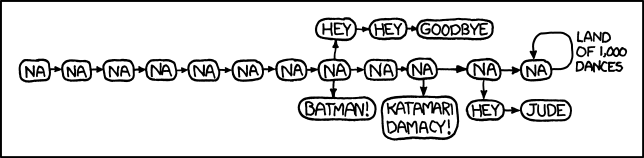
Randall Munroe has provided us with a beautiful example of conceptual compression:

Music Humor From www.xkcd.com

Sunday, January 23, 2011

Music and the Brain: Dopamine

Consider this the third installment of a likely indefinite series of posts about music and the brain.  The first post is a primer and a recommended read.  The second post was about a study by 3/5 of the same authors that directly led to this one.

The last discussed study provided solid evidence that when pleasure is experienced from music (particularly in a manner that exhibits chills), that feeling of pleasure arises out of measurable psychophysiological emotional arousal.  It left us with a hint of wonder about whether dopamine plays a role in such pleasure, as the anticipation-reward pattern of pleasure when listening to music seems comparable to the anticipation-reward pattern that dopamine seems to play a major role in based on other studies.


ResearchBlogging.orgSalimpoor, V., Benovoy, M., Larcher, K., Dagher, A., & Zatorre, R. (2011). Anatomically distinct dopamine release during anticipation and experience of peak emotion to music Nature Neuroscience, 14 (2), 257-262 DOI: 10.1038/nn.2726
[HTML] [PDF]

The author's introduce this work by dutifully citing previous research related to their hypothesis and noting their desire to fill in an important piece of the puzzle:
...previous neuroimaging studies have implicated emotion and reward circuits of the brain during pleasurable music listening, particularly the ventral striatum, suggesting the possible involvement of dopaminergic mechanisms. However, the role of dopamine has never been directly tested.
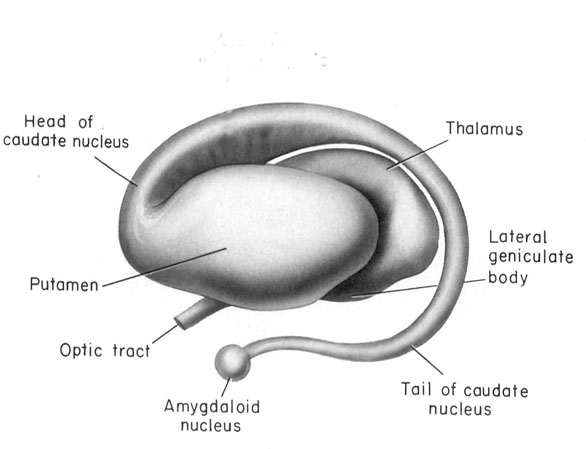
Ventral stri-what?  The striatum is a region of the brain that actively uses dopamine for its purposes and contains other, more specific nuclei of interest.  It has been connected to the experience of reward in previous studies.  "Ventral" essentially means "lower."

Striatum, Thalamus, and Amygdala

The putamen (also called the lenticular (it looks like a lens) nucleus) and the caudate (it looks like a tail) nucleus make up the striatum.  The most significant citation of research that involved the ventral striatum is that of Anne J. Blood and R. Zatorre (again): Intensely Pleasurable Responses to Music Correlate With Activity in Brain Regions Implicated in Reward and Emotion [PDF].  It's important to note that the striatum has been associated with dopamine and reward, which I'll talk more about later.

There is some previous work that involved the subject of dopamine, but it isn't research that directly tested its involvement to the degree that this study does.  The most significant of that research is that of  V. Menon and D.J. Levitin (who is at McGill, of course): The Rewards of Music Listening: Response and Physiological Connectivity of the Mesolimbic System [PDF].

Side note: Daniel Levitin is a name worth remembering.  He wrote This is Your Brain on Music, which was the first book that I read that dealt with this subject matter.  That book, as well as his research mentioned above, was cited in the first study that I discussed in my last post.

The authors of this research found participants who experience chills in response to certain pieces of music.  That should sound familiar if you read my last post.  In fact, both of these studies began with a pool of 217 respondents, which seems to strongly indicate the same group of people.  It's likely that after running the tests discussed in the initial study, they kept using the same people for this one.  The tests designed for this study use a Positron Emission Tomography (PET) scanner as well as a Functional Magnetic Resonance Imaging (fMRI) unit.  Using both of these brain imaging devices in a study enabled them to benefit from the advantages of each and even overlay their information to make certain discoveries.

Even with the complex background, the results of this study are surprisingly simple.  Dopamine was found to be released (most significantly) in the caudate nucleus and the nucleus accumbens (NAcc).  The NAcc is part of the ventral striatum.

Striatum and Amygdala

The results get better.  Because the researchers were able to compare the timing of neurological activity to the timing of participant-indicated pleasure (and chills) during the music, they determined that the caudate releases dopamine when the listener is anticipating a chill, a moment of peak pleasure, and that the NAcc releases dopamine when the reward, the peak pleasure, arrives.

This figure pretty much says it all.

This is downright exciting, because before music was used as a stimulus during research about dopamine and the limbic reward system, researchers had to measure anticipation and reward separately.  With music, it has now been demonstrated, researchers can measure the transition between the two in real time.  This also gives us insight into how the brain responds to the abstract stimulus of music and related anticipation.


I tried to limit the length of my discussion of this research so that I could have room at the end of this post for other things.  With that in mind, I highly recommend reading Jonah Lehrer's blog post reviewing the study, as he uses a couple great quotes from the research and also discusses the role of anticipation in music in a fairly effective and very approachable way (he cites Leonard Meyer too - surprised?).

I can quickly think of a few pieces of music that reliably give me chills and elicit profound emotional responses.  Franz Biebl's arrangement of Ave Maria and Z. Randall Stroope's arrangement of I Am Not Yours are the choral works that come to mind.  These would actually not qualify as selections for this research for two reasons; they have words and I have performed them before.  Those characteristics invite additional variables to the possible causes of emotional activity in the brain, and I find it valuable that these researchers made the attempt to avoid such interferences.  After such a study, however, I would be very interested to find out how people's brains act differently when listening to a chill-inducing piece that they have performed.

The strongest emotional reaction from me in response purely to musical sounds comes from German Brass's arrangement and performance of J.S. Bach's Toccata and Fugue in D minor.  The first time I heard it I almost cried when the final chord was held.  Call me a sap, but my reaction is almost that severe every time I listen to that recording.

There have been some interesting neurological studies demonstrating the similarity between brain activity while performing an action or experiencing a stimulus and while imagining the same action or stimulus.  Before looking up videos for the three pieces I mentioned, I first imagined bits and pieces of each, and while merely imagining their sounds I experienced chills.  This has happened to me before, and I would be very interested to gather neurological images of brains imagining a chill-inducing musical moment in comparison to when they actually hear the music.

While reading these studies I consistently found tangential relationships to the subject of learning.  Consider this passage from the Discussion section of this research:
This subregion of the striatum is interconnected with sensory, motor and associative regions of the brain and has been typically implicated in learning of stimulus-response associations...

previous studies involving rewards such as food and smoking that contain a number of contextual predicting cues...also found dorsal striatum dopamine release.  Conversely, in studies in which there were no contextual cues or experience with the drugs involved, dopamine release was largely observed in the ventral striatum...

as rewards become better predicted, the responses that initiated in the ventral regions move more dorsally in the striatum.
Studying this proposed model of associative learning by using music as a stimulus could be very effective.  These authors express an interest in determining whether the anticipation that they studied is more a result of participants having learned the specific sounds of their musical selections or of participants having learned the contextual cues present in most western music.  I suspect that study of people experiencing pleasure during the first listen of a piece of music or the first listen of a style of music that follows rules they are unfamiliar with would be able to address that question as well as mine about the location of neurological activity during one's initial pleasurable experience in response to a piece of music.

The authors of this research do attempt to determine if the activity of the caudate and the NAcc are the same when chills aren't present, and do so by repeating certain analyses with the moments that participants experienced chills ignored.  They conclude that activity is similarly correlated to pleasure, but I think this really needs to be studied in people who do not experience chills in response to music.  If you look again at the last figure above, you'll see that the most dramatic changes in activity occur during the experience of a chill.  Since "the specific experience of chills is not necessary to result in neural activity in the striatum," could we please see if the same dramatic changes occur for those who don't experience chills, and then appropriately compare analyses of the different scenarios?  I hope we get to, sometime.

Gee, I hope I wrote enough.

Friday, January 21, 2011

Music and the Brain: Emotion

At the end of my primer on music and the brain, I said that the research I intend to discuss attempts to answer these questions:

  • How is emotion tied to the experience of enjoying music?
  • What physiological or chemical cues can tell us more about how the brain interprets music?
  • What is the role of anticipation in the brain when listening to music?

  • I meant to include two studies in this post (as well as a section of additional commentary!) but my writing about the first one was too extensive.  The second study (the one in recent news) will be discussed in my next post.


    ResearchBlogging.orgSalimpoor, V., Benovoy, M., Longo, G., Cooperstock, J., & Zatorre, R. (2009). The Rewarding Aspects of Music Listening Are Related to Degree of Emotional Arousal PLoS ONE, 4 (10) DOI: 10.1371/journal.pone.0007487
    [HTML] [PDF]
    The authors of this study begin their introduction with this:
    Why is music pleasurable?...there are no direct functional similarities between music and other pleasure-producing stimuli: it has no clearly established biological value (cf., food, love, and sex), no tangible basis (cf., pharmacological drugs and monetary rewards), and no known additive properties (cf., gambling and nicotine).  Despite this, music is consistently ranked amongst the top ten things that individuals find highly pleasurable...
    Seen through the lenses of psychologists, "Why is music pleasurable?" becomes an investigation of "whether there is a systematic relationship between dynamic increases in pleasure states and physiological indicators of emotional arousal."  The authors determined that if they could monitor a person's subjective feelings of pleasure simultaneously against objective measurements of emotional arousal, they could begin to confirm their hypothesis.  That wouldn't be enough, however, unless they also demonstrate that when listener's do not find a piece of music to be pleasurable, physiological indicators of emotional arousal remain static; this is opposed to the possibility of such indicators responding to the stimuli of music without an accompanying change in felt emotion.  If one subject listens to a musical excerpt that they enjoy so much it gives them chills, and another subject listens to the same piece of music and feels emotionally unswayed by it, the measurements of physiological indicators of emotion would be able to determine whether musical pleasure is a result of measurable emotional increase or if, instead, musical pleasure is unrelated to emotional arousal.  In the authors' words,
    We tested the hypothesis that if the rewarding aspects of music listening are indeed a result of the emotional states produced, there would be a positive correlation between emotional arousal and pleasure states.  It further follows that a lack of pleasurable responses should also be accompanied by low emotional arousal.
    I struggled at first to differentiate the psychological ideas of "pleasure" and "emotion" as they are used here, for I'm used to identifying pleasure as an emotion by definition.  To separate the two, I gave consideration to things I would consider pleasurable that are doubtfully related to physiological changes in my body and brain that have been established as the causes of emotion.  Laying in bed on a Saturday morning with no plans, I may be awake but stationary for minutes at a time, simply enjoying being relaxed.  This kind of relaxed enjoyment does not, in my understanding, fit into the category of an emotional experience as defined by observed physiological signatures.  I hope that helps.

    These researchers chose a novel approach to experimenting with music and emotion by using only music selected by participants in their study.  They sought subjects who experience chills (an interesting and established phenomenon considered valuable in music and emotion research) while listening to particular pieces of music.  Then they used these selections for all participants, and linked each selection to two people: one who loves it and gets chills, and one who recognizes it and finds it neutral or boring.


    By using participant-selected music, they were able to get very reliable results regarding chills, and by using the same piece of music for a participant who finds it boring, they were able to negate all of the factors that musical stimuli produce and thereby compare emotional arousal most effectively.  Success in this would add much to the "little empirical evidence to suggest that emotional arousal is directly related to music's rewarding properties."

    Subjects would be hooked up to devices measuring skin conductance (GSR), temperature, heart rate, blood volume pulse amplitude, and respiration rate.  This data would be measured while they listen to music, and they would also press buttons on another device to indicate whether they were experiencing "low pleasure," "high pleasure," "chills," or were relatively "neutral."


    Ultimately, I'm convinced that they succeeded in confirming their hypothesis with "data [that] revealed a strong positive association between subjective ratings of pleasure and autonomic nervous system arousal," and by demonstrating that "participants who reported to increases in pleasure in response to...the same excerpts did not show any significant increases in [emotional measurements]."


    I've just started reading Emotion and Meaning in Music by Leonard B. Meyer.  This 1956 treatise discusses two ideas that relate to this study.  In the first chapter, Meyer defines in detail the philosophical and psychological understanding of emotion and argues, persuasively, that psychophysiologically, one emotion is indistinguishable from another — emotional arousal is always the same, and the emotion that is ultimately felt and claimed by a person depends on the stimuli or context at hand.  For instance, skydiving can be extraordinarily exciting while falling off a tall building would be frightening, yet the physiological sources of emotion would be quite the same,  though experienced differently.  Based on my reading of this study, that argument seems to be the predominant viewpoint today.  He also lays out an excellent foundation for the pursuit of a more objective understanding of how anticipation is involved and manipulated in music.  Music is unique in that a piece of music creates its own context and is self-referential, enabling a listener's anticipation and expectancies to be manipulated with great accuracy.  The next study deals more directly with anticipation, but there is a figure from this one that provides good visual sneak preview.


    (Oh, by the way, the authors of this paper actually cite Meyer's book.  In addition, they also cite David Huron's Sweet Anticipation: Music and the Psychology of Expectation (2006), which is, coincidentally, resting on my table as the next book on my reading list.  I suppose this means I'm reading the right materials, which makes me happy.)

    In addition to all of this, there were two secondary pursuits within this study.  The first was regarding the chills that participants experienced; they sought to further confirm the value and understanding of them.  They found that "over 80% of chills occurred at the highest moments of pleasure," which is nice, but now I wonder what was different about the 20% of chills that occurred at moments that did not "correspond with peak pleasure responses."

    The second was practically a jab at other music research.  They demonstrate through surveying participants that the emotions they felt in response to the musical selections were not necessarily the same as the emotions that they thought the music intended.  The authors conclude,
    This finding reveals a major flaw in current paradigms of research with music and emotions, with compulsory implications for future studies.  Although it seems intuitive that felt emotions are different than perceived emotions, this distinction has not been acknowledged in the majority of previous studies.
    Ouch.

    At the end of the Discussion section of the paper, the authors make a tantalizing note: "The intensity of pleasure experienced...has lead some researchers to suggest that [music] may act upon the dopamine reward system of the brain," and that "whether or not dopamine is actually involved remains to be determined..."  This question directly led to the 2011 research discussed in my next post, and, if true, would add another piece of the brain to the growing list of those known to be involved in listening to music.

    Wednesday, January 19, 2011

    Music and the Brain: A Primer

    Damn, I love good research.

    I came across a newly published study of people's emotional responses to music, noted that I recognized one of the authors (Robert Zatorre of McGill University) and was reminded of research a couple of years ago by 3/5 of the same authors.

    Side note: I'm rather tempted to pursue academic study of music and the brain (I like to call it the budding field of neuromusicology) in Montréal, seeing as Zatorre is at McGill and co-directs the BRAMS International Labratory for Brain, Music, and Sound Research with another favorite researcher of mine, Isabelle Peretz at the Université de Montréal.

    In my next post, I'm going to give overviews of the two studies mentioned above and discuss some thoughts about them.  First, however, I will give a citation-free, pistachio-sized nutshell of a primer on what is known about the relationship between music and the brain.

    Primer


    The Ear and Temporal Lobes


    The experience of listening to music begins, of course, at the ear.  Tiny hair cells in the cochlea respond to fluid vibrations effected by the bones of the middle ear.  These bones respond physically to pressure; specifically, changes in air pressure (sound waves).

    The Ear (with a really long canal).

    Hair cells respond to different frequencies (which define pitch) and amplitudes (volume) and send a neurological signal into the brain — they make the transition between the physical and the chemical aspects of sonic transmission.

    The Cochlea and Its Hair Cells

    The signals sent by these cells are primarily directed to the temporal lobes of the brain.  The temporal lobes are known to interpret the signal information as frequency, amplitude, and duration, which together account for all audible variations in sound.

    The Left Temporal Lobe

    Cool, yes?  Well, this happens for all sound, be it music, speech, or sonic boom.  There must be other parts of the brain that interpret everything that makes music music.


    The Frontal Lobe and Cerebellum


    The elements of music are more profound than the elements of sound; harmony, tempo, and melody must at least be included.  I'll get harmony out of the way first.  When discussed in terms of the relationship between simultaneous pitches, I am willing to simplify and chalk it up to the temporal lobes.  When discussed in terms of the underlying tonalities of music, consider it to be more in line with melody, discussed below.

    If you've ever been caught up in the pounding *thump*thump*thump*thump* of loud club music, you probably don't need much convincing that tempo has a primitive, reptillian characteristic in our brains.  If you aren't so easily swayed, consider the beating of hearts.  The necessity to keep hearts pumping with tempo has been around in our evolutionary history much longer than the luxury of understanding melody (well beyond when we were reptiles).  If you still aren't convinced, bugger off, I'm trying to give a primer here!

    The part of the brain responsible for keeping our heartbeat is the cerebellum, part of the "reptillian brain."

    The Cerebellum

    The same part of the brain that controls the beat of a heart plays a huge role in interpreting the beat of music (tempo).  I know you're shocked, but take a deep breath and we'll move on.

    Melody is a complicated beast; without both pitch variation and rhythm it can't exist.  Melody is more of an abstract concept than previously discussed elements.  Whereas other items can be objectively measured, there is no unit of melody — no physical characteristic by which it can be defined.  Fortunately, we have brainstuff (can we please make that an official word, Webster's?) that is well-suited to the abstract.  Behold the frontal lobe:


    This incredible region of the brain plays the largest role in conceptualizing the abstract.  In the case of musical melody, it's actually doubly suited, because it also conceptualizes the future, and therefore effects the feeling of anticipation.  Composers make their livings by toying with anticipation (or by selling insurance, but I'm trying to be positive).  Almost all music creates interest by defining a tonal home base and then straying from it; stringing the listener along until it returns with resolution.  The tried and true structure of western melody does exactly this (so does the underlying structure of harmony, hence their strong relationship).


    Emotion and Memory


    I've heard rumor that when some people listen to music, they experience "emotions."  I know it sounds like gibberish, but there are parts of our brains that are measurably active when people experience "feelings," including the ones allegedly sparked by music.  Though emotional activity in the brain requires interactions between multiple regions, the primary one is the amygdala.

    The Amygdala

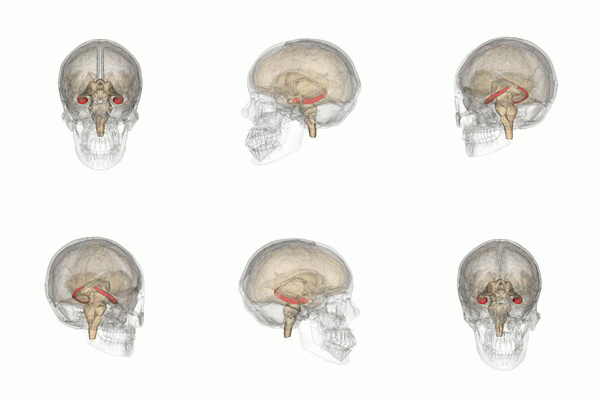
    Music can have the effect of inducing memory recall of items ranging from associated lyrics to an event in one's past.  The primary region of the brain involved in forming and recalling memories is the hippocampus.

    The Hippocampus

    Hippocampus is Greek for "seahorse."


    Still to Learn


    So much.  In short, the questions that the soon-to-be-discussed research attempt to address are:
    • How is emotion tied to the experience of enjoying music?
    • What physiological or chemical cues can tell us more about how the brain interprets music?
    • What is the role of anticipation in the brain when listening to music?
    Feel free to ask questions!

    Sunday, January 9, 2011

    Fabricated Nostalgia - A Discussion of Vinyl Records

    About a year ago, the music faculty of the college I attended decided to freely distribute their record collection, as it was about to be replaced by a purchase of a CD library (I know that seems behind the times, but I know no details about what collection they were purchasing, and these records were just taking up space).  I gathered numerous records, focusing on those that likely had not been redistributed on CD, even though I had no way to play them.

    As a holiday gift, I received from my parents a turntable.  I recently set it up and am very much enjoying the experience of using this mechanism.

    I want to get out of the way the idea that I might end up espousing the tired arguments that vinyl records sound better, or are more true to the performance they recreate.  While my knowledge of audio engineering is limited, it is complete enough that I feel confident in stating that all legitimate concerns about digital audio have been overcome.  Ultimately, the purity and durability of modern digital recording and reproduction far exceeds that of [even modern] analog-to-vinyl recording and reproduction.  Instead, my discussion (soliloquy, perhaps) is meant to be centered on the experience of using this technology:

    I imagine it would be quite difficult to play records without feeling a more palpable and personal awareness of, and connection to, the music that one listens to.  I even feel a stronger sense of ownership of the music that I have on records than the music I have stored on my computer.

    One must interact with records in order to hear what they contain.  To select a track, the onus of visually seeking the proper location on the record on which to drop the needle requires a conviction that, while trivial, is hardly present in the process of selecting a track on a computer.  Continuing to listen to a complete album (nay, a complete Wagner opera, as I've done), requires attention; the listener has to move the arm, stop the spin of the record, flip the record (or select the next continuation), spin it, and play it.

    On that note, I wish to point out the silly convention that I've discovered.  If there is a 10-disc series, parts 1 and 10 are opposite sides of one disc, 2 and 9 the next, 3 and 8, 4 and 7, and 5 and 6.  This requires a lot more fiddling around than a 1/2, 3/4, 5/6 pattern would.
    (Edit: Commenter davew has humbled me by explaining that some record players were designed to stack records and flip them over according to this convention.  I would say that I wish I had one of those to play 10-disc operas, but that would sort of fly in the face of my "more interaction with the media by paying attention to the changing of discs" theory, wouldn't it?)

    Another discovery; I seem to be more a product of the computer age than I thought.  I was just beginning to write about the value of the booklets included with these albums that I have when I realized that many CD releases have such a thing, too.  My exposure to CD's has been primarily through modern rock music, and those albums rarely even include lyrics, but it's possible that CD's of the orchestral, choral, or operatic variety do include informative booklets as well.  The type just isn't as big.

    I'm finding that the information included with these records is quite interesting.  I'm currently listening to "A Toscanini Treasury of Historic Broadcasts" (1967), which contains a letter from the Chairman of the Board of RCA, a biography of Toscanini, many photographs, as well as notes about each included recording.  Below is a video consisting of the "Notes on the Music" title page and the NBC symphony's 1949 performance of the first movement, the Adagio, of Haydn's 99th symphony.  The notes describe it so:
    Here...from the typical opening Adagio to the vivace Finale, the string writing conforms closely to the quartet style, in which the leading voice passes from instrument to instrument, and there is hardly a consideration of "melody" and "accompaniment." In the Adagio the oboes, clarinets, and bassoons are blended into the whole with a prophetic sense of the place they would occupy in the orchestra palette of the future.

    Through this set of vinyl records, I feel more connected to this history.  As an analogy, it's great to be able to listen to the oldest known recording of a voice...

    Au Claire da la Lune

    ...but how incredible would it be to physically play the original phonautogram?

    Ultimately, I can't resist considering how much interaction other forms of musical reproduction require.  I grew up with cassettes, which were fairly pure and very durable, but extremely frustrating when I wanted to play just one song.  Then I used CD's, which I think are rapidly fading as a standard.  Before the widespread use of computers for music storage and playback, CD's did require a certain amount of interaction and care. but were much easier to forget about during use than vinyl records are.  Still, I like being able to download music at my desk and have it play within seconds.  I wonder what Toscanini would think.

    I'll leave you with this magnification of a vinyl record's groove.

    Thursday, December 30, 2010

    The Application Process

    This is my understanding of how most people in most professions get a job:

    1. Get help from your college if you're about to graduate, check job-posting sites online (especially those within your industry), check classifieds, check an individual company's website if they interest you especially.
    2. Send your résumé and cover letter to the places you wish to work.
    3. Await responses and requests for letters of recommendation, continue searching, and follow up on leads and top choices.


    This is the process of getting a job in education:

    1. Apply for certification in the state in which you wish to work.
    2. Your college doesn't really help (mine didn't (probably because it's just too hard)).
    3. Find the state's best job-posting site (if you live in the same state as me, you'll soon discover that it is a mediocre source at best).  Find a couple of nationwide educational job sites (and then discover that their information rarely lines up with actual openings).  Read classifieds.
    3.5. If searching across state borders, discover that not only is it a hassle to determine exactly which states accept certification from your current state, but also that they all have their own uniquely flawed methods of disorganization.
    4. Realize that your best bet is to go to the school district website for anywhere you may want to work (this is painfully overwhelming if you're not so sure where you want to work) and search for their own postings.
    5. (This is supposed to be equivalent to #2 above).  Determine how the district wishes you to apply and the materials that they want.  Realize that these will not be consistent.  Some want it to be online, some want it to be directly from a certain third-party website (which may require you to mail them things first), some want mail, and some want in-person (this is a possibility for other professions as well, I suspect).
    6. Gather the materials that are asked for most often.  Child abuse clearance, state police clearance, FBI fingerprint clearance (you might cry when you realize that many districts want to see your original documents and make copies themselves, which requires either a lot of driving or some weird calls to places that are too far to drive to), your FBI clearance registration number, a standard state application, any additional downloadable application from their website (yes, they often ask for both), proof of PRAXIS scores (you may have to request and pay for these, I did), college transcript, copy of teaching certificate or a letter from you education department explaining that it is pending, possibly an ID number issued by the state which you can't get until you're certified, and letters of recommendation.
    7. Fill out the plethora of applications.  Some will ask for bizarre things like where you went to elementary school.  Some will ask for questionably legal things like access to your income tax history (and give you a W-4 to fill out).  Some will ask for your high school transcript.  Some will ask for transcripts from colleges from which you transferred.  Some will ask for proof of a negative TB test.  Some will ask for the federal I-9 form.  If filling out applications online, discover that school districts do not have high quality websites.
    8. Sacrifice a Chiltan Markhor.

    They fight back.


    As a tribute to the stunning new film Black Swan, I invite you to enjoy...

    Swan Lake, Act IV Finale (iTunes)

    Wednesday, November 17, 2010

    11/17

    I was very glad to have Mrs. D back today for choir, as a pianist and consultant.

    After Theory, Mrs. D pointed out to me that one student has been getting more disrespectful toward me.  I hadn't noticed, which seems like a pretty disappointing oversight of mine considering the mere five students in the class.

    Have you ever tried to explain ledger lines to a 12-year old with a learning disability?  How about 28 at once?  Such a feat isn't rocket science...it's harder.

    Hourglass Nebula
    I forgot to mention a great teaching moment from yesterday.  We have many posters up in our room, and one of them is of the hourglass nebula.  It came up in conversation and the students asked me what a nebula is.  Well, I explained it, as well as answered other tangential questions, and managed to keep the conversation under five minutes while still getting their minds spinning.  I love those moments.

    I can't seem to find a previously blogged explanation of a significant part of my educational philosophy as it relates to moments like that (Edit: Found it, 9/1).  I find it extremely valuable for students to see their teacher as more than a container of knowledge on one subject, but instead as a more complete person who knows about other things, too.  The best manifestation of this is when I'm able to connect something from another subject to music, but times when I get to briefly teach them about something completely unrelated are still very satisfying.


    The Boxer - Carbon Leaf

    Saturday, October 30, 2010

    10/29

    Yesterday was Halloween dress-up day.
    I was Nathan Detroit (Guys and Dolls)
    Mrs. D was Cruella Deville (101 Dalmations)
    I was monitoring some students in in-school suspension and noticed that one of them was in there for the day because she does not participate in Halloween.  It reminds me that the school did not officially refer to Halloween for this spirit day, but instead (and in the theme of an anti-drug week) as "Say 'Boo!' to drugs day."  I need to find out if the full-time suspension monitor knows if that was a parental or student decision.  I'm not particularly inclined to rant about Halloween in schools — try to stifle your disappointment.

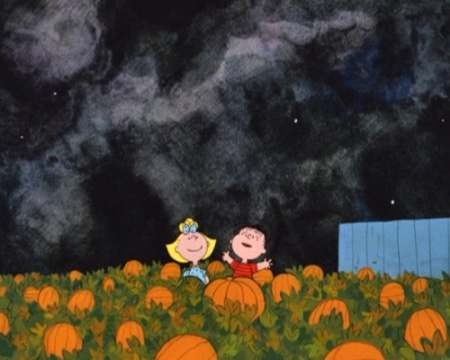
    In GM, we watched "It's The Great Pumpkin, Charlie Brown" (because we can).  I haven't seen this video in such a long time that I got to enjoy a new discovery of how amazing it is.  Off the top of my head, it's the only kid-oriented story on film that I can think of that doesn't teach the lesson, "If you believe really hard in something, it will happen."  Linus firmly believes in the Great Pumpkin and waits for it all night and it never comes.  So instead of another "Hey kids, magic stuff is real — keep at it" movie, this is a movie that seems to say, "Hey kids, it's ok if something that you really wish for doesn't arrive, life goes on anyway, and deeper beauty and meaning exists (in friendship and in nature)."  I love it.

    Imagery like this makes me happy.


    I ended the day by attending a specialized meeting with representatives from different teams (Mrs. D represents the arts here) and the principal and VP.  It was...boring!  Yet, also informative.  Enough of that, I have another day to talk about...

    Today was a clerical day post-marking-period.  We finalized grades and began preparation for the next marking period (we fortunately get another day, Monday, for this as well).  I worked on creating seating charts based on IEP and medical information (vision and hearing, for example).  In looking at my rosters, I know I'm going to have my hands full.  There are many ADHD students in these classes and many with IEP's, too.

    One class in particular is going to be the adventure of a lifetime.  Mrs. D and I have been warned THREE TIMES about this group of students, with phrases like, "this is the kind of class that could make someone run away screaming from education."  We met with a teacher who works with these students (though not all at once, is my understanding) to figure out who to avoid sitting next to whom.  He did help with this, and he also informed us (almost one by one) about the very low-performing faculties of these students and their behavioral...let's say "quirks."  He also said to us, and I quote directly, "This is honestly the lowest set of students that I've seen."  28/30 of these students have IEP's, by the way.  Fortunately, their learning support teacher will be with us during each class.  Mrs. D will be trying to let me be entirely in control of the class but will, when needed, be a valuable presence and extra set of eyes — perhaps also an enforcer if I don't cut it some day.  My expectations for this class will, and need to be, completely different than that of others; I'll be progressing in the curriculum at a dramatically slower pace.  Some of these students read at a 2nd grade level.  I get the impression that if I can make it through teaching this class, there is absolutely nothing pedagogical that would keep me from certification.

    Please forgive my late-night lazy storytelling, but I need to wrap this up.  The last memorable event of the day was hearing about a situation in which some HS seniors were found to be expecting Mrs. D to drive them between two music events on a weekend without ever having asked her.  Furthermore, she had to drive them around today due to their poor planning.  SENIORS!  WAKE UP!


    The Oldest Established (Guys and Dolls)